


.png)
DN and PN: What You Need to Know for the Right Selection

Güncelleme tarihi: 28 Şub
What Is DN? (Nominal Diameter) 📐
DN (Nominal Size / Nominal Diameter) is a standardized nominal size designation used for piping components. It does not mean “the actual inside diameter is X mm”; it’s a standardized size label. Components labeled with the same DN (valves, flanges, fittings) are meant to match within the same size class.
DN = a size standard (label)
The actual inside diameter can vary depending on wall thickness, the standard used (Schedule, etc.), and the manufacturer.
In the European/metric system, DN roughly corresponds to NPS in the inch-based system (approximately the “same size class”).

How to Read DN on Site? ⌀
It goes as DN15, DN20, DN25, and so on.
When you say “a DN50 valve,” it’s expected to match DN50 flanges/fittings depending on the connection standard used in the system.
What Is PN? (Nominal Pressure) 🌡️
PN (Nominal Pressure) is a numerical designation that indicates the pressure class of components. The key point: a PN value is not a fixed guarantee of “this many bar under all conditions.” It’s a reference nominal value, and the allowable pressure decreases depending on temperature and material group (derating).
You’ll see PN10, PN16, PN25, PN40, etc.
Parts with the same DN and the same PN class are generally selected to work compatibly together.
As temperature increases, the allowable pressure decreases for most materials (especially in steam and hot-oil applications).

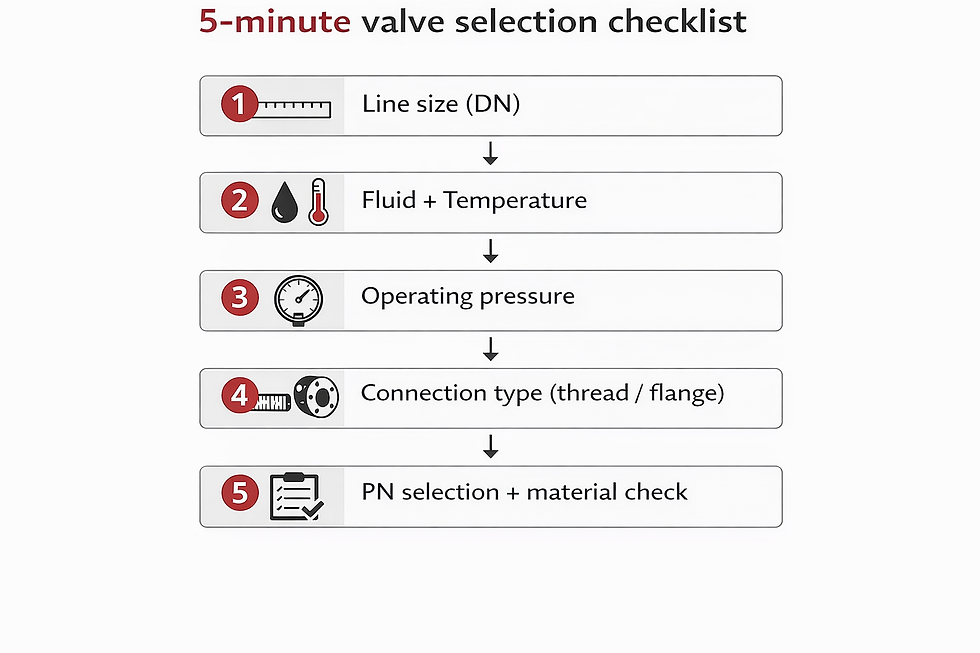
The Right Sizing in 5 Minutes (Step by Step) DN – PN
1️⃣ Clarify the Line Size (DN Is Determined by the Line)
What DN is your pipeline? (It’s stated in the project, or you measure it on site.)
No choosing a valve just because “DN25 sounds right.” The line size determines the DN.
Rule: The valve DN is selected the same as the line DN (unless a specific flow/Kv calculation is required).
2️⃣ Write Down the Fluid + Temperature + Pressure (PN Is Determined by These)
Three inputs:
Fluid: water / air / steam / hot oil / chemical
Operating temperature (°C)
Operating pressure (bar)
PN selection is not just “this many bar is enough”; it also takes into account allowable pressure values that decrease with temperature.
3️⃣ Choose the Connection Type (Flanged or Threaded?)
On threaded connections, instead of “PN” you may sometimes see the product’s max. working pressure or an ANSI class rating.
On flanged equipment, PN is more clearly standardized (the EN 1092-1 world).
4️⃣ Choose PN Safely (Practical Selection Logic)
A common on-site approach:
Cold/warm water, low risk: PN10–PN16
General industrial use, pumping lines: PN16–PN25
Steam / high temperature / safety-critical: often PN25–PN40 and above (but the real key here is material + temperature derating)
Because allowable pressure under a given PN class can drop as temperature rises, the “PN16 = 16 bar, done” mindset makes people’s piping systems cry.
5️⃣ Check the Material and the Standard (Stainless or Carbon Steel?)
If there is corrosion/chemical exposure: choose a stainless steel body and suitable sealing materials.
In services like steam: body strength and packing type are critical.
Mini Quick Table (For a Quick Reminder) 📏
Yaygın Hat Etiketi | Yaklaşık karşılığı |
DN15 | ~1/2" |
DN20 | ~3/4" |
DN25 | ~1" |
DN32 | ~1 1/4" |
DN40 | ~1 1/2" |
DN50 | ~2" |
(This is an “approximate” match; DN does not mean the actual diameter.)
Most Common On-Site Mistakes (and Their Consequences) ⚠️
Reducing DN (chokes the flow, causes pressure loss, cavitation, and noise)
Choosing PN without considering temperature (the “I bought PN16 for steam” disaster)
Mixing connection standards (EN 1092-1 PN flanges vs other standards)
Choosing incompatible materials in stainless connections (galvanic issues, thread stripping, etc.)
A Quick Shortcut to the Right Product Pages on the Site 🔗
Master, so you can get there without getting lost in the categories:
Click for All Valve Categories / Valve Group: (A filterable structure is available, such as ball, butterfly, globe, actuated, stainless on-off, needle valves, etc.)
Click for Stainless Steel Connection Components: (Flanges, camlock couplings, blind flanges, and connection hardware.)